

Client Nightmare – The Rogue MSP
Case Study: Why Clean Offboarding Brings Clients Back
The Timeline
Eleven years ago, we onboarded a new client. For nine years, we managed their entire IT environment—servers, workstations, network infrastructure, cloud services, business continuity and disaster recovery (BCDR, or backups), the works. Then, two years ago, they decided to try a different approach and we offboarded them to another MSP.
We kept in touch and, in February, the conversation changed from “we’re not satisfied with our current MSP” to “what are the options for switching back to CTC”. They were a fantastic client that we enjoyed working with so we were game.
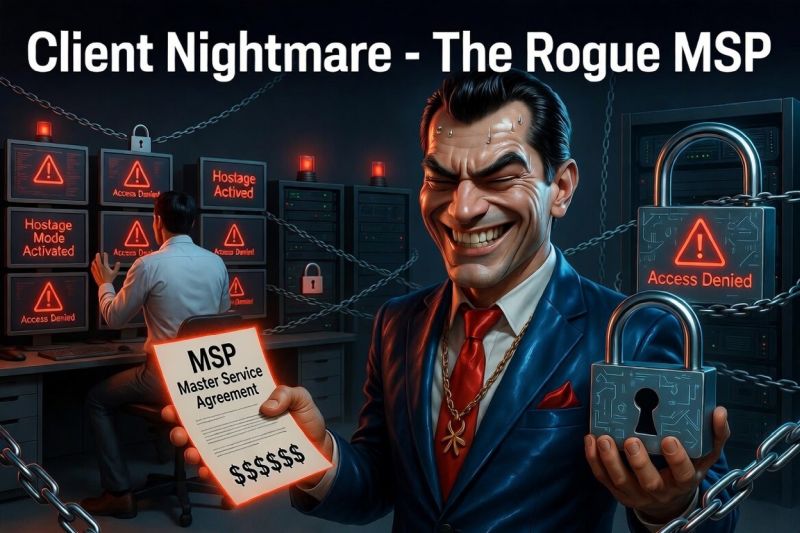
But it’s now late May, and we’re still negotiating just to get their own credentials back. It’s been a masterclass in what can go wrong when your MSP values lock-in over partnership.
Why This Matters
Most MSPs view a departing client as a failure—a relationship soured, a contract lost, a competitor won. We don’t see it that way.
Businesses change IT providers for lots of reasons: pricing, service model differences, new technology needs, or simply wanting to see if the grass is greener. Sometimes it works out. Sometimes it doesn’t. But if you make the exit painful, you guarantee they’ll never return—even if they want to.
This client spent two years with another MSP. During that time, they got locked into long-term agreements, found themselves with infrastructure they didn’t fully own or control, and discovered that “partnership” meant something very different than it did with us. They also experienced how vendor management (or lack thereof) can create real problems—like when their new MSP’s exclusive relationship with a vendor allowed that vendor to restore the MSP’s access to systems even after the client had explicitly removed them.
When they decided to make a change, they remembered how we handled their exit two years ago: documented, professional, and with all credentials and access transferred cleanly.
The Hard Truth About MSP Trust
When you hire an MSP, you’re handing over the keys to your kingdom. Helpdesk support. Infrastructure management. Network security. BCDR. License planning, procurement and management. Vendor management. You’re trusting that vendor to make decisions that align with your business interests—not theirs, and not their vendor partners’.
That’s a lot of power to hand over. And unfortunately, not every MSP treats it with the care it deserves.
When it’s time to leave, you find out exactly how much control you actually have. In this case: not much. Despite a clear desire to switch in February, we’re approaching June and still navigating hurdles around credential handoffs, data removal, and what “complete offboarding” actually means.
Questions Your MSP Should Never Fear
When your MSP recommends a server refresh or proposes switching backup vendors, you should feel 100% comfortable asking:
- “Why do we need this?”
- “What problem does this solve?”
- “Are you receiving compensation from this vendor?”
- “How does this compare to alternatives on both performance and price?”
- “Is this helping my business, or just your margins?”
- “If I want to buy this hardware or software from someone else, is that a problem?”
A trustworthy MSP welcomes these questions. If yours gets defensive—or insists you must buy through them—that tells you everything you need to know.
The Term Agreement Trap
Here’s a line we’ve seen too many times: “The term is 24 months, but you can leave with 30 days notice if you’re unhappy.”
Sounds reasonable—until you try to exercise that clause and discover:
- The “termination process” isn’t documented anywhere
- Your data export “isn’t covered” under support
- Critical credentials are withheld until the final payment clears
- Your vendor relationships (Microsoft 365, backup providers, etc.) are controlled by the MSP and their exclusive partnerships—not you
- The “pro-rated refund” you assumed existed… doesn’t
- “Thirty days” becomes three months of back-and-forth while you’re stuck paying for service you’re not receiving
If your MSP requires a term agreement, your escape hatch must be crystal clear and legally enforceable. Not a handshake. Not a verbal promise. Not something that requires a signed settlement agreement just to get your own credentials back. In writing. Specific timelines. Specific deliverables. Specific consequences if they don’t cooperate.
Three months (and counting) of experiencing the alternative has reminded this client exactly why that matters.
How MyIT is Different
This situation reinforced why we built MyIT the way we did:
No term agreements. You’re with us because you want to be, not because you have to be. If you decide to leave, we help you leave—cleanly, completely, and with everything you need to succeed with your next partner. We proved that two years ago, and they remembered.
You own everything. Your Microsoft 365 tenant is in your name. Your firewall is licensed to you. Your endpoint protection and BCDR contracts are yours. Your vendor relationships are yours. Yes, this costs more upfront than the “We’ll handle it all for $X/month” model. But you control your own destiny. We literally cannot hold you hostage because we never held the keys—and we don’t have exclusive partnerships that bypass your authority.
You source where you want. If you want to buy your hardware from CDW, your software directly from Microsoft, or your firewalls from a local reseller, we’re 100% OK with it. We don’t require you to purchase through us to get our support. We’ll still help you configure it, deploy it, and manage it—whether we sold it to you or not.
Full transparency. We’ll tell you exactly why we’re recommending what we’re recommending—including if we’re reselling it to you at a mark-up. No kickbacks hidden in the fine print. No “partnerships” that mysteriously align with our highest-margin offerings. No exclusive vendor deals that put your MSP’s interests before yours.
The Bottom Line
Business relationships change. That’s not failure—it’s business. But how those relationships end matters just as much as how they begin.
When you treat offboarding as an opportunity to demonstrate professionalism—not as a chance to punish someone for leaving, delay their transition, or extract maximum value on the way out—you create something rare: a former client who trusts you enough to come back.
This client left two years ago. They called in February to come back. It’s nearly June, and we’re still working through the complications of an offboarding process that should have taken days, not months.
Is your MSP relationship built to last, or built to lock you in? And if you needed to leave tomorrow, would they help you leave in 30 days—or would you still be fighting for your own credentials three months later?
—
Nathan Underwood
General Purpose Rental Geek
Cyber Tech Café